The Eisbach wave: a surf break in a city park
Compiled by Surf Haunts · Updated 2026-10-20
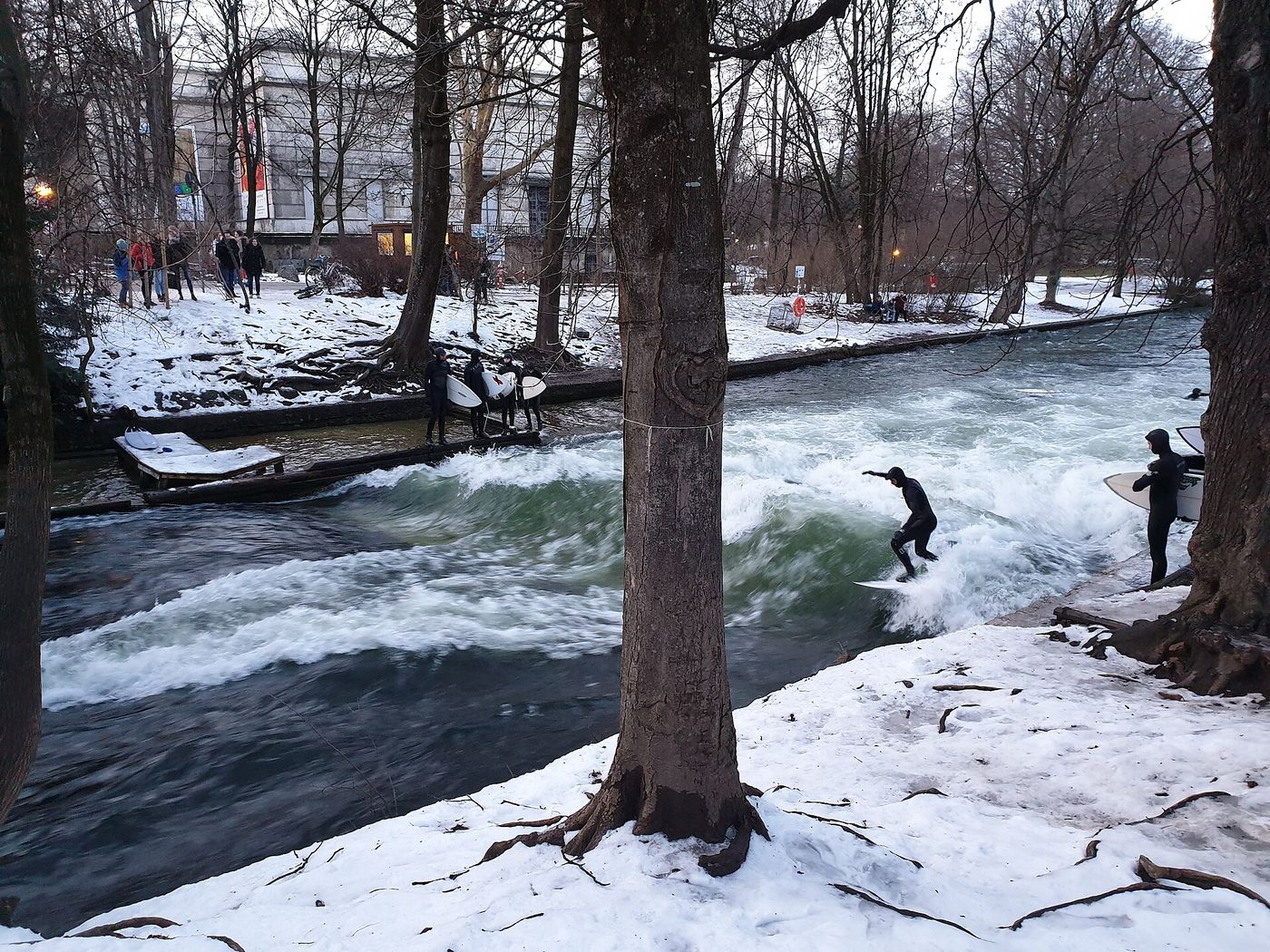
The Eisbach is a small, fast side channel of the river Isar that runs through Munich's English Garden. At its southern end, just north of the Prinzregentenstrasse bridge and beside the Haus der Kunst, the water forms a standing wave. People have surfed it for decades, in the middle of a city, hundreds of kilometres from any coast.
A wave that took shape by accident
The city's own description of the site places the wave at the southern end of the English Garden, where a standing wave emerged after alterations to the channel in the 1970s. Nobody designed it for surfing. The 2026 municipal order on the Eisbach is explicit that the wave is not generated or built for surfing, and that its form depends on hydraulic works and water management. Change the flow, and the wave changes with it.
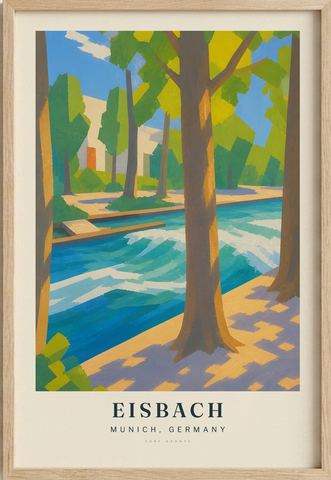
That matters for how we drew it. Our print shows the channel, the band of white water and the dense park trees. It does not show a particular day's wave, because there is no fixed wave to show.
Not the first river surf in Munich
It is tempting to call the Eisbach the place where river surfing started. Munich's own history says otherwise: surfing on the city's rivers began at the Floßlände in the early 1970s, before the Eisbach wave became internationally known. The Eisbach is the famous one, not the first.
2010: the city gives surfing a legal basis
For years, surfing the Eisbach was tolerated at best. The city's own account of its "Münchner Originale" describes an earlier prohibition, a land swap with the state of Bavaria and the municipal basis for board surfing that followed in 2010. The contemporary record is the city's official gazette of May 2010, which permitted board surfing at the designated wave under defined conditions.
That was a milestone, not a permanent guarantee. Whether surfing is allowed on a given day has continued to depend on the state of the wave and on the city's current orders. We don't repeat those here; they change, and the city publishes them itself.
A wave that comes and goes
Because the wave depends on the water, it has disappeared and returned. In 2025–26, after work on the waterway, the familiar shape vanished and later came back, as the Süddeutsche Zeitung's chronology records. It is a good reminder that this surf spot is a piece of hydraulics in a public park, not a natural reef.
Were you there in the early years?
If you surfed the Eisbach or the Floßlände in the 1970s or 1980s and have photographs with a date, email us. We'd like to add first-hand detail, and we'll ask before publishing anything and agree how to credit you.
Our Eisbach print
Our Eisbach print centres the narrow channel and its standing band of white water between the park's trees, with the city kept out of the frame. It is an illustration of the place, not a record of its conditions.
Compiled from public historical sources and fact-checked against them at the time of writing – not a first-hand or local account. Corrections and memories are welcome; we verify before publishing anything sent in.