Muizenberg: huts, trains and a board in 1919
Compiled by Surf Haunts · Updated 2026-10-20
Muizenberg is the wide, gentle beach on False Bay where most people in Cape Town first stand on a surfboard. Its coloured, gabled huts have come to stand for the place.
A post on the road to Simon's Town
The village began as a military post. The Dutch established Muizenberg in 1743 on the road between Cape Town and Simon's Town, and it took its name from Wynand Willem Muijs, the sergeant in charge of the post, who later commanded the Cape garrison. What turned a post into a seaside town was the railway: the line from Wynberg reached Muizenberg on 15 December 1882, and the beach was suddenly a short ride from the city.
The first photograph of a surfer
South African surfing is usually dated from here. By 1910 surfing was popular at Muizenberg, and a 1918 brochure from the Cape Peninsula Publicity Association called surfing at the Cape "a cult". The best-known moment came in 1919, when Heather Price, on holiday in Cape Town, borrowed a board from two American Marines and became the first surfer photographed standing on a wave here.
Three years later a famous visitor followed. In February 1922 Agatha Christie, travelling with her husband Archie, took the train out to Muizenberg to buy boards – ones with curved ends, she wrote to her mother, because they were easier and less painful to use. The Christie estate cites her autobiography and her letters for the episode, and the beach later turned up in her novel The Man in the Brown Suit.
Brighton, bans and a surf shop
In the 1930s Muizenberg was South Africa's premier holiday destination, nicknamed "the Brighton of South Africa". The same account records harder decades: the apartheid legislation of 1953 that segregated the beaches, and a 1964 council ban on surfing between Surfer's Corner and the pavilion. Surfing came back. Peter Wright opened The Corner Surf Shop, the town's oldest, on the corner of Main and York Roads in 1971, and in September 2026 the local heritage society opened an exhibition on that whole history at the Het Posthuys Museum.
The huts
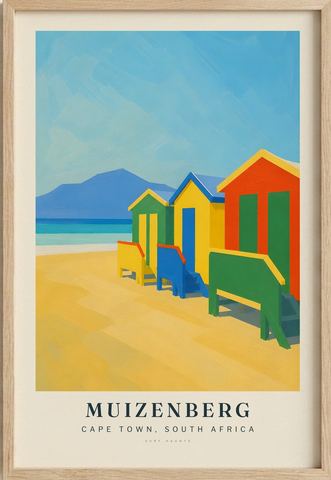
The coloured huts are older than the surf shops. The City of Cape Town's own guide to its beaches lists them as a historical reference and a windbreak at Muizenberg and Surfer's Corner. They are not fixed objects, though. As part of a beachfront upgrade that began in 2025, the city is replacing eight huts in the central section with new huts that keep the historic design, colours and pattern, set a little further from the water. So the print is a composition, not an inventory: it does not claim to show the current number or order of the huts.
Do you know the beach?
If you or your family surfed Muizenberg in the early decades and have dated photographs, email us. We'll ask before publishing anything and agree how to credit you.
Our Muizenberg print
Our Muizenberg print steps three gabled huts diagonally into the frame – green, yellow, red and blue, separated by cream roof edges – over warm sand, with a narrow band of False Bay and the mountain silhouette behind.
Compiled from public historical sources and fact-checked against them at the time of writing – not a first-hand or local account. Corrections and memories are welcome; we verify before publishing anything sent in.