Jardim do Mar: a village, a wave and a wall
Compiled by Surf Haunts · Updated 2026-10-20
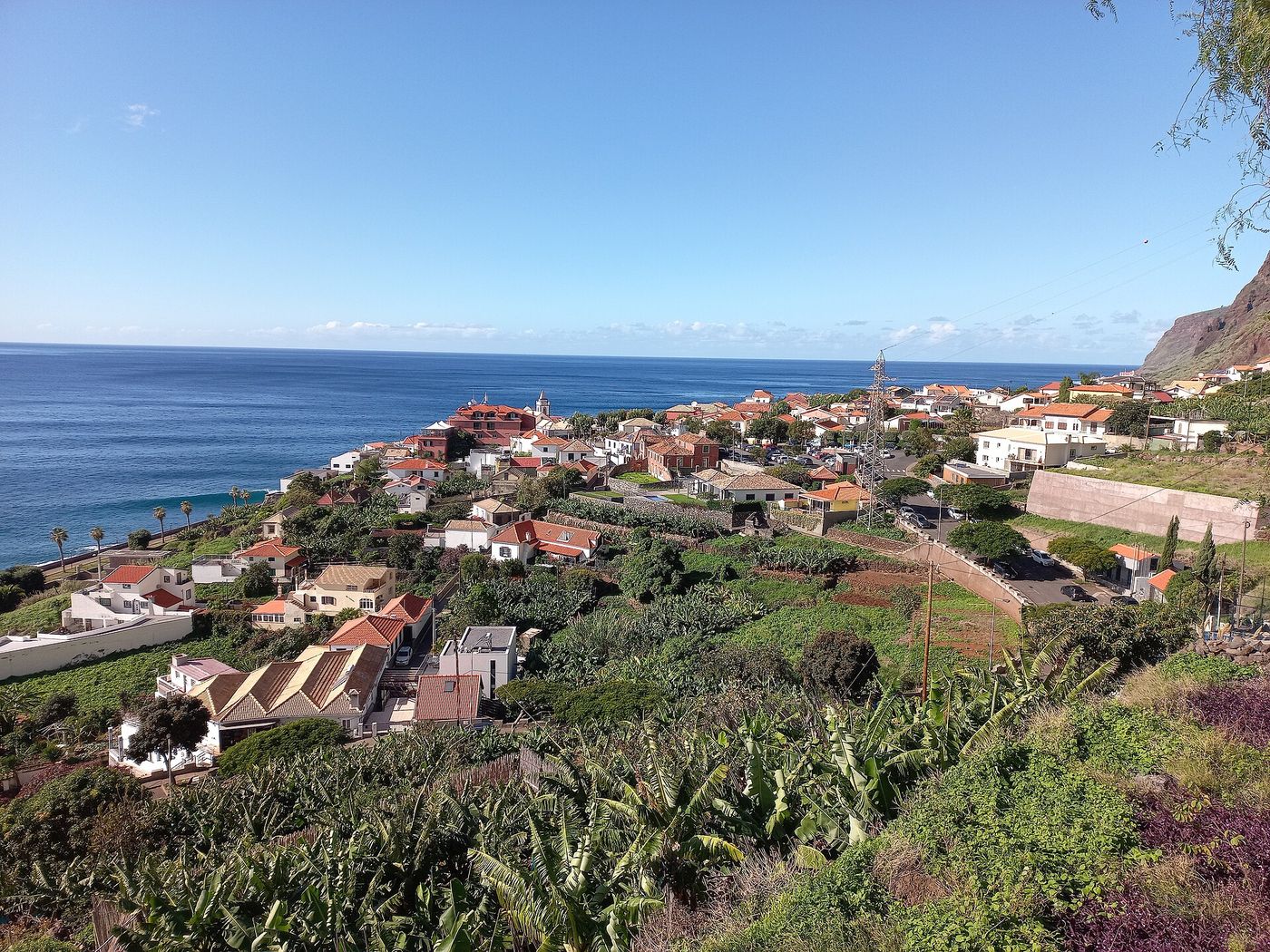
Jardim do Mar is a small parish on Madeira's south-west coast, built on a fajã – a shelf of flat land at the foot of the cliffs. The municipality of Calheta describes it as a place of low houses, narrow streets and a church at the centre, pressed between steep rock and the Atlantic. The present church, Our Lady of the Rosary, was blessed in 1907. The long waterfront wall below the village has a story of its own.
The European Hawaii
For a few years around the turn of the century, Jardim do Mar was one of the most talked-about waves in Europe. SurferToday's history of the break records that the French editor Gibus de Soultrait saw its potential in the early 1970s, that a 1994 magazine feature brought surf travellers, and that the spot hosted the Billabong Challenge in 1997 and big-wave events around 2000–2001. The nickname "European Hawaii" dates from that period.
The wall
Then the waterfront changed. The regional government built a seawall and paved a road along the shore in the early 2000s. Save the Waves Coalition, which campaigned against the project, describes a wall that covers roughly thirty feet of natural shoreline and leaves the wave surfable for far less of each tide than before. The Portuguese surfers' association S.O.S. Salvem o Surf, founded in 2002, gave technical support to the civic movement in 2003, according to the association's history as summarised on Wikipedia; we have not found a current statement from the association itself about Jardim do Mar.
The exact year differs between accounts, so we don't put one on it. What the records agree on is that the shoreline below the village is an engineered edge, not an old fortification, and that the regional government later carried out further work at the Portinho, the small pier, including a rehabilitation of the Solário do Portinho in 2018.
Why the print keeps the wall
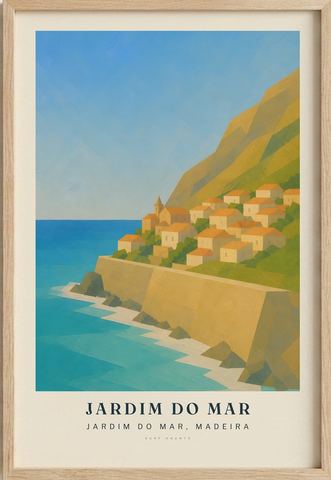
We could have painted the village without it. We kept the wall because it is what you see, and because it is part of the place's history now. In the print it draws a clean line beneath the orange roofs; the sea on the other side is painted, not measured.
Portugal's other story in this series is on the mainland: the fort and the red light above Nazaré's Praia do Norte, a very different coast with a very different history.
Did you surf it before the wall?
If you have photographs of Jardim do Mar from the 1990s or earlier, email us. We'd like to show what the shoreline looked like, and we'll ask before publishing anything and agree how to credit you.
Our Jardim do Mar print
Our Jardim do Mar print looks across the waterfront towards cream walls, orange roofs and a slender church tower, with the mountain pressing down from above and broad Atlantic blue on the other side.
Compiled from public historical sources and fact-checked against them at the time of writing – not a first-hand or local account. Corrections and memories are welcome; we verify before publishing anything sent in.