Nazaré: a fort, a red light and the canyon below
Compiled by Surf Haunts · Updated 2026-10-20
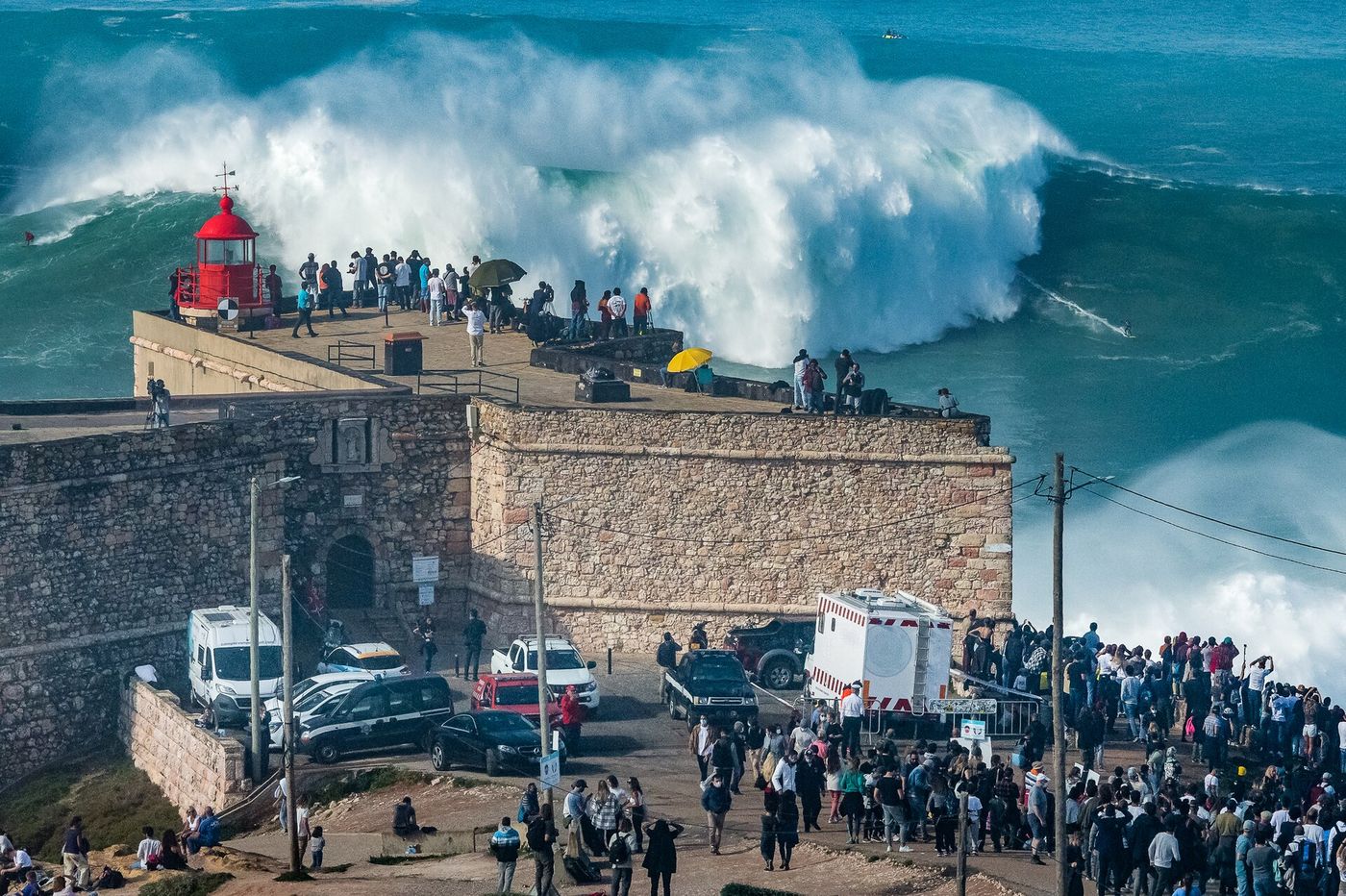
Most pictures of Nazaré are about the waves. Ours is about what stays still while the water moves: Forte de São Miguel Arcanjo, the pale fort on the Sítio promontory, and the small red light on its roof. Both have a dated history. The waves do not, and this page keeps the two apart.
A fort that began in 1577
The municipality of Nazaré records that construction of the fort began in 1577 and that it was expanded in 1644. It was built to watch the coast, not the surf. For most of its life, the Atlantic below was simply the sea that fishermen worked and that the fort guarded against.
The fort stands on the promontory of Sítio da Nazaré, above Praia do Norte, the beach to the north of the town. From the walls the view is almost entirely water, which is why the building became the natural place to put a light.
The red light, 1903
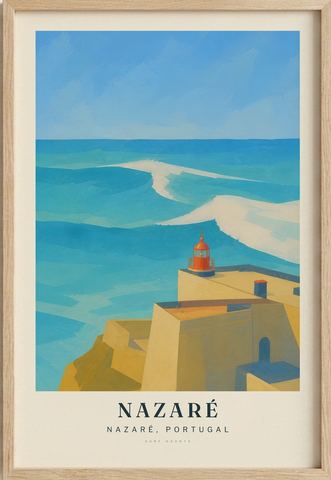
According to the same municipal record, a harbor light began operating at the fort in 1903. It is a modest cylinder on the roofline, red against the cream masonry, and it is the one precise colour in the whole scene. In our print it is deliberately tiny: a fixed mark that the eye can hold while everything else in the frame is movement.
The fort is still a heritage site open to the public. In early 2026 the municipality noted that it had passed three million visitors, most of them drawn by the view over Praia do Norte.
What the canyon does
Off Praia do Norte lies the Nazaré Canyon, a deep underwater valley that runs towards the shore. Portugal's hydrographic institute explains that the canyon changes how swell travels and can create zones where wave energy converges and is amplified close to the coast. NASA's Earth Observatory describes the same mechanism, with satellite images showing the scale of the canyon.
Two things matter here. The canyon does not make big waves on its own; it needs the right swell, period and wind to work with. And no wave in our print is a measured one. The crests are painted large to show the contrast between fixed stone and moving water, not to record a particular day.
Nazaré is one of two Portuguese places in our series. The other, Jardim do Mar on Madeira, is a village on a coastal shelf whose story is about a wave and a wall rather than a fort.
Do you know the fort?
If you have family photographs of the promontory, the light or the old town with a date and a place, email us. We'd like to add local detail, and we'll ask before publishing anything and agree how to credit you.
Our Nazaré print
Our Nazaré print sets the fort low in one corner, the red light on its roof, and lets turquoise and white water take over the rest of the frame. It is an illustration of a relationship, stone against sea, rather than a photograph of any single swell.
Compiled from public historical sources and fact-checked against them at the time of writing – not a first-hand or local account. Corrections and memories are welcome; we verify before publishing anything sent in.